
December 28, 2024
Natural vs. Synthetic: Understanding Skincare Ingredients
The skincare industry often pits "natural" against "synthetic" as if they're opposing forces. The reality is far more nuanced—and understanding this can help you make better choices for your skin.
The Natural Misconception
Many people assume that "natural" automatically means "better" or "safer." However:
– Poison ivy is natural
– Many plants contain irritants
– Natural preservatives may be less effective
– "Natural" has no regulated definition
The Synthetic Reality
Similarly, "synthetic" doesn't mean harmful:
– Many peptides are synthesized for purity
– Lab-created ingredients can be identical to natural ones
– Synthesis ensures consistency and safety
– Some of the most effective ingredients are synthetic
What Really Matters
Instead of focusing on natural vs. synthetic, consider:
1. Efficacy: Does the ingredient actually work?
– Look for clinical studies
– Check concentrations used
– Evaluate delivery methods
2. Safety: Has it been tested?
– Review safety data
– Consider your skin type
– Check for potential allergens
3. Formulation: How is it presented?
– pH levels matter
– Stability is crucial
– Delivery systems affect penetration
4. Source Quality: Where does it come from?
– Purity standards
– Manufacturing practices
– Quality control measures
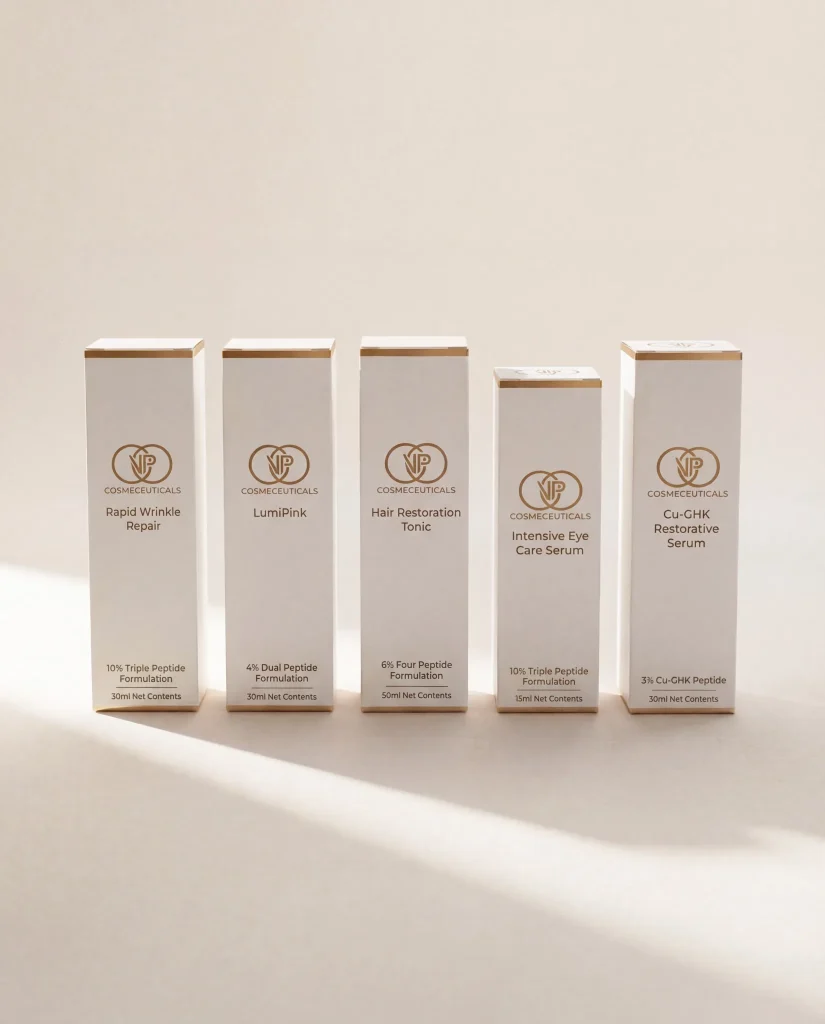
The VP Cosmo Approach
At VP Cosmo, we combine the best of both worlds:
– Ultra-pure peptides produced under strict laboratory conditions
– Naturally-derived botanical ingredients
– Minimal, naturally-derived preservatives
– No artificial fragrances or harmful additives
Our philosophy is simple: use what works, whether it comes from nature or the lab, as long as it's safe and effective.